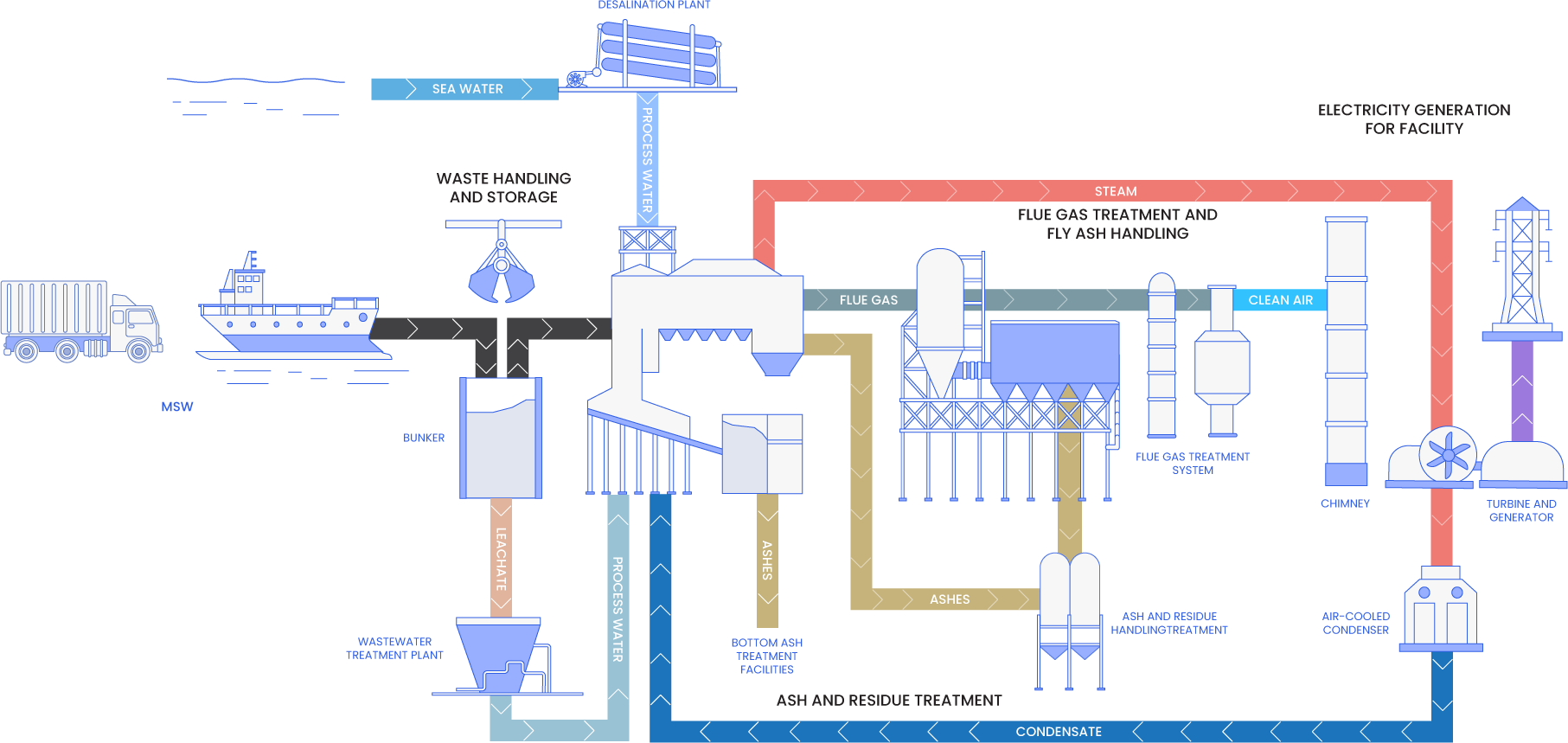
This is a simplified version of the MSW treatment process.
Reception
MSW is collected and mainly transported to the facility by vessel.
Incineration
Advanced Incineration
Utilises cutting-edge ”3T” technology to control temperature, time, and high turbulence flow, maintaining combustion temperatures above 850 degrees Celsius for at least two seconds to ensure thorough combustion and destruction of organic pollutants, including dioxins.
Moving Grate Incineration Technology
I•PARK2 adopts moving grate incineration technology, which is the mainstream thermal technology for handling mixed MSW. It can achieve a larger waste treatment capacity with a smaller footprint and significantly reduce the waste volume by about 90% upon treatment, capable of meeting the long-term and large-scale waste disposal demand, with features of high efficiency, reliability, maturity and cost-effectiveness. Moving grate incineration is widely adopted in the Mainland and around the world for most large-scale WtE incinerators under operation and construction.
Electricity Generation
Heat generated from burning waste is recovered. Heat is then used to generate steam in the boiler and the steam drives the turbine to generate electricity for on-stie use, with surplus electricity to be exported to the power grid. It is expected to export approximately 960 million kilowatt-hours of surplus electricity to the power grid annually.
Flue Gas Treatment and Fly Ash Handling
Advanced air pollution control systems will be adopted to treat the air pollutants in the flue gas and the flue as emissions will be continuously monitored to ensure compliance with the stringent emission standards (benchmarked with the more advanced and stringent standards as recognised internationally standards including the National Standard and European Union standards).
The associated fly ash will be solidified with cement or stabilised with chemicals for safe disposal at landfills to minimize environmental pollution, with all solidified/stabilised products tested to meet Incineration Residue Pollution Control Limits.
Resource Recovery of Incinerator Bottom Ash
During the incineration process, the non-combustible residue of combustion in the incineration system, i.e. bottom ash, at a size of only 10% of the original volume, will be collected. The bottom ash contains mainly inert materials of minimal environmental impact and relatively low recycling value, such as glass and ceramic, and also a small amount of ferrous and non-ferrous metals of higher recycling value. Separators will extract ferrous and non-ferrous metals from the bottom ash for material recovery. They can be then turned into recycled products such as low-carbon green building materials, including low-carbon cement, non-structural concrete aggregates, and road sub-base interlayer aggregates, thus maximising resource recovery and minimising landfill disposal.
Integrated Water Management
I•PARK2’s integrated water management comprises the desalination system, the stormwater drainage system and the wastewater management system.
The desalination system is designed to produce water from seawater with the purpose to support the overall function and operation of the plant, including the key elements of process water and potable water.
The stormwater drainage system is designed to adequately manage stormwater while establishing a rainwater collection system for use as reclaimed water as well as the interception of first flush of surface runoff for treatment and subsequent reuse.
The wastewater management system consists of multiple wastewater treatment systems to treat wastewater produced and collected from the facility for treated effluent reuse, for example, irrigation, toilet flushing and road washing, within the plant to meet the zero-discharge objective.